Dash the Sea Arrow

Dash is an Atlantic puffin. His wings beat about 9 times every second, and he cruises over the sea at about 63 km/h.

Wings that swim

When Dash dives, he keeps flying. Under the water a puffin swims with its wings and steers with its orange feet.

A bill full of fish

Backward-pointing spines inside his mouth hold each fish, so he can open his bill for the next one. Worldwide, Atlantic puffins are listed Vulnerable by the IUCN.

Week 25 · Atlantic Puffin

Atlantic Puffin: Dash the Sea Arrow

Fratercula arctica
TURBO FLAPPERS

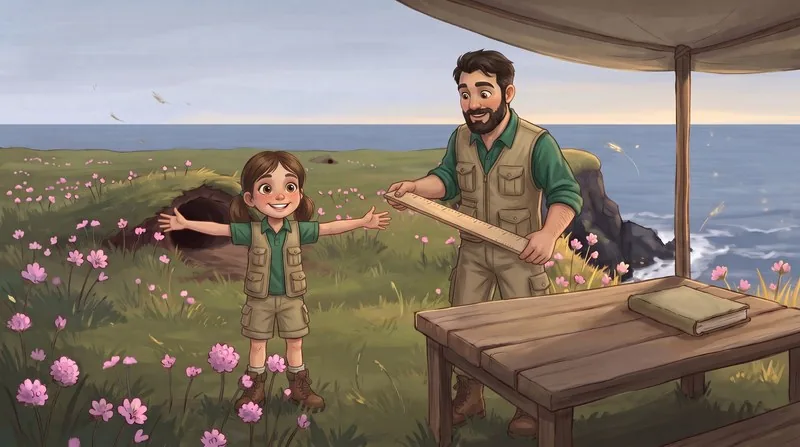
Dash beats his short wings about nine times every second. He swoops down from the cliff to the sea, then dives in and keeps flying, under the water, with the very same wings. He is a little shorter than a school ruler.

Dash the Sea Arrow
The superpower

Short wings that flap nine times a second, in the air and under the sea

Atlantic Puffin scene

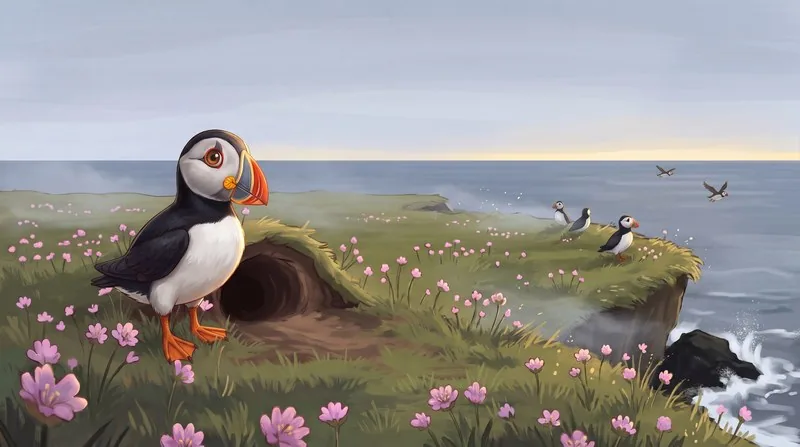
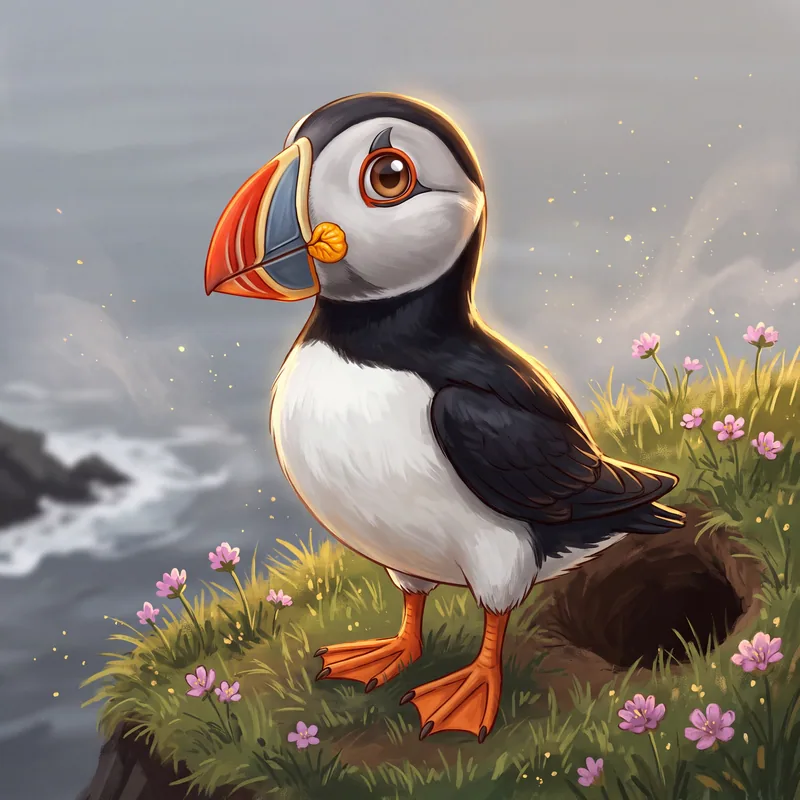
Dash is an Atlantic puffin. He comes ashore only to raise a family, on grassy cliff-tops and rocky slopes of islands in the cold North Atlantic, from Maine and Greenland to Iceland, Norway and Britain. The rest of the year he lives far out at sea. He is 26 to 29 centimeters (10 to 11.5 inches) long, and he weighs 310 to 550 grams (11 to 19 ounces). His back, wings and collar are black, and his belly is white. His face is greyish white, with a red ring round each eye. His feet are bright orange. His big striped beak has a pale yellow rim, blue-grey plates and a red-orange tip.

The power is the flappers. His wings are short, and they beat about nine times every second, around 550 times a minute. He cruises at about 63 kilometers an hour (39 miles an hour), and he flies faster still when he dives from the cliffs toward the sea. Under the water the same wings swim. They push on the way up as well as the way down, while his feet steer. Most of his fish are caught within 30 meters (98 feet) of the surface, and most dives last 20 to 30 seconds. Back at the colony, he and his mate dig a burrow in the turf or under the boulders, and one egg is kept warm by both of them.

A little shorter than a school ruler. About nine wingbeats every second, and the same wings swim.
Free for grown-ups

Dash's Explorer's Hunt is on its way

A free mystery hunt about the Atlantic puffin, to print at home. Mariana and Fenekie are still hiding the clues. Strike's Explorer's Hunt is ready now.

Watch & listen

Two ways to meet Dash

Podcast A · Discovery

Meet Dash, the Sea Arrow

A daytime conversation. Meet the animal, and the one thing that makes it a superhero.

Podcast B · Bedtime

Dash and the Beak Full of Silver

A gentle narrated story to drift off to. It ends with lights out.

Rather just listen? Both are podcasts too: Explorer Club on Spotify, Bedtime Stories on Spotify, or any other podcast app.

Dash the Sea Arrow storybook cover

The storybook

Twenty-one painted scenes follow Dash from a green cliff in the cold North Atlantic. A puffin a little shorter than a school ruler listens for a peep from under the grass. Short wings. Nine beats a second. A beak full of silver. And one morning, the sea below the cliff is empty. How far will he fly? For curious explorers, ages 4-8.

Find it on Amazon
Take one home

Dash's keepsakes are on their way

We are still painting Dash the Sea Arrow's stickers, shirts and prints. The rest of the club is already in the shop.

Wonder facts

Things you wouldn't believe are true

1

A puffin can hold a row of little silver fish in his beak while he catches more. About 10 is a normal load, and the British record is 62.

2

Every summer his beak grows colourful plates. After the breeding season, a set of them falls off, and the plates grow back before the next season.

3

The red-orange part of his beak gains a groove as he gets older. Puffins do not usually breed until they have at least two.

4

Two wild puffins have been seen scratching an itch with a stick. It was the first time a wild bird was recorded doing that.

VU
Vulnerable
IUCN Red List, 2018
Verified at iucnredlist.org

Vulnerable since 2015, his fish are moving

Dash's kind, the Atlantic puffin, is listed Vulnerable by the IUCN, the group that tracks how animals are doing worldwide. It was last checked in 2018, and it has been Vulnerable at every review since 2015. Its numbers are falling. In Europe, where most puffins breed, the kind is listed Endangered. As the sea warms, the small fish that puffins feed their chicks, sandeels and young herring, move or become hard to find. Many of Iceland's colonies have almost always failed to raise chicks since 2003. There is hope, too. In March 2024 the UK and Scottish governments closed their waters to sandeel fishing to protect seabirds. In Maine, Project Puffin brought chicks back to an island that had lost its puffins, and a record 213 burrows were counted there in 2026. In Iceland, local children search the streets at night for lost pufflings that mistake town lights for the moon. In 2024 they rescued more than 4,200. 1% of all Fenekie Explorer Club sales supports wildlife conservation.

Atlantic Puffin facts

  • What it isThe Atlantic puffin is a small seabird in the auk family. It is the only puffin that lives in the Atlantic Ocean.
  • Say itIts scientific name, Fratercula arctica, is fra-TUR-kew-la ARK-tik-a. Fratercula is usually explained as little brother or little friar.
  • SizeIt is 26 to 29 cm (10 to 11.5 in) long, a bit shorter than a school ruler. It weighs 310 to 550 g (11 to 19 oz).
  • Where it livesIt spends most of the year far out on the cold North Atlantic. It nests on grassy island cliff-tops from Maine and Greenland to Britain, Iceland, Norway and Russia.
  • What it eatsIt eats small fish, such as sandeels, sprat, herring, capelin and hake. In Maine it also eats krill.
  • Day or nightIt is awake by day and does its fishing in daylight. At night it does not feed, and at sea it sleeps floating on the water.
  • BabiesIt lays one egg in a burrow. Both parents keep it warm for 36 to 45 days, then feed the chick, called a puffling, for 38 to 44 days.
  • Who hunts itGreat black-backed gulls are its main hunter and can catch adults in mid-air. Great skuas hunt it too. Herring gulls take eggs and chicks. Mink and rats raid burrows.
  • Where it came fromIts closest living relative is the North Pacific's horned puffin. Bones of a puffin much like it, from early Pliocene rocks about 4 million years old, were found in North Carolina.