Inky the Savanna Stomper

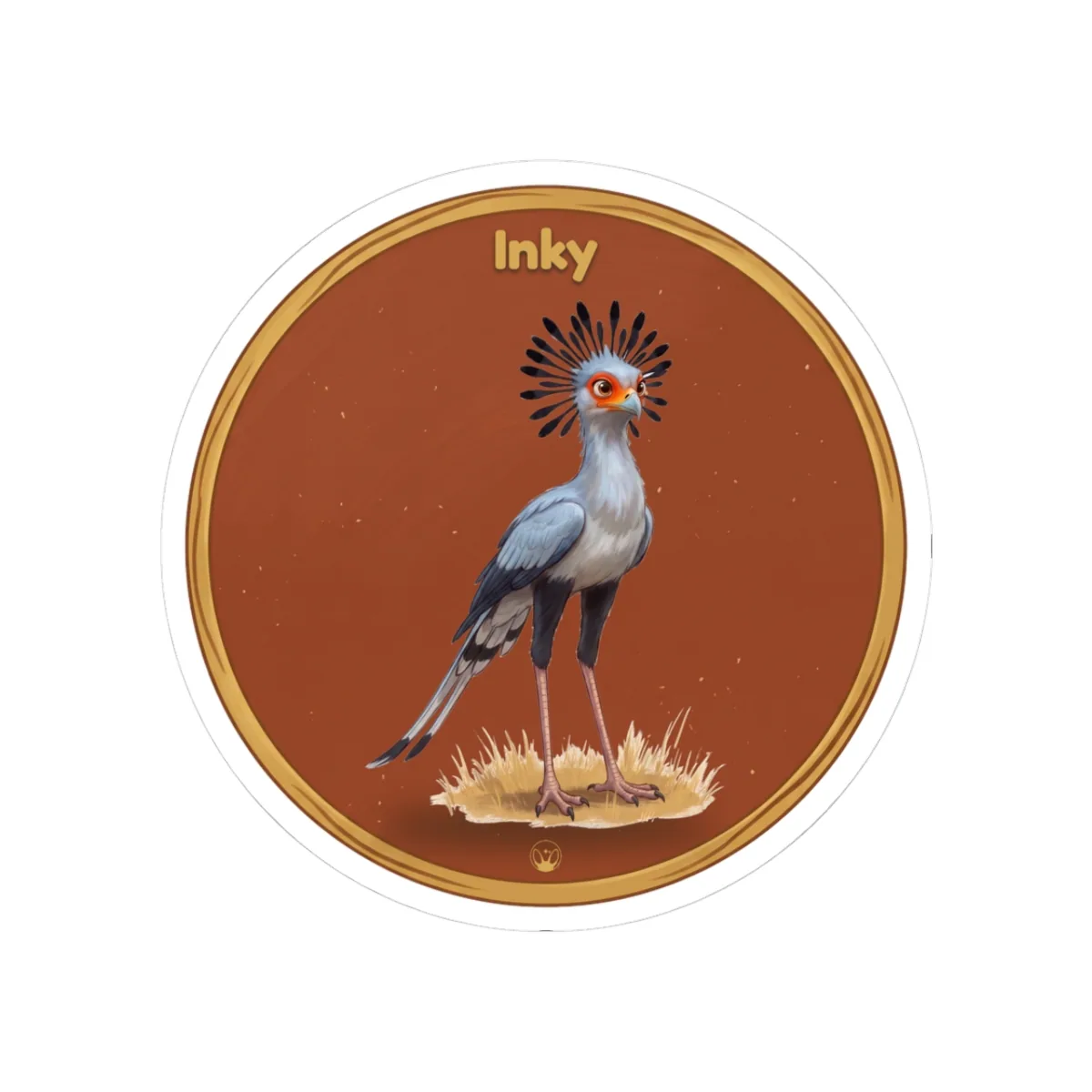
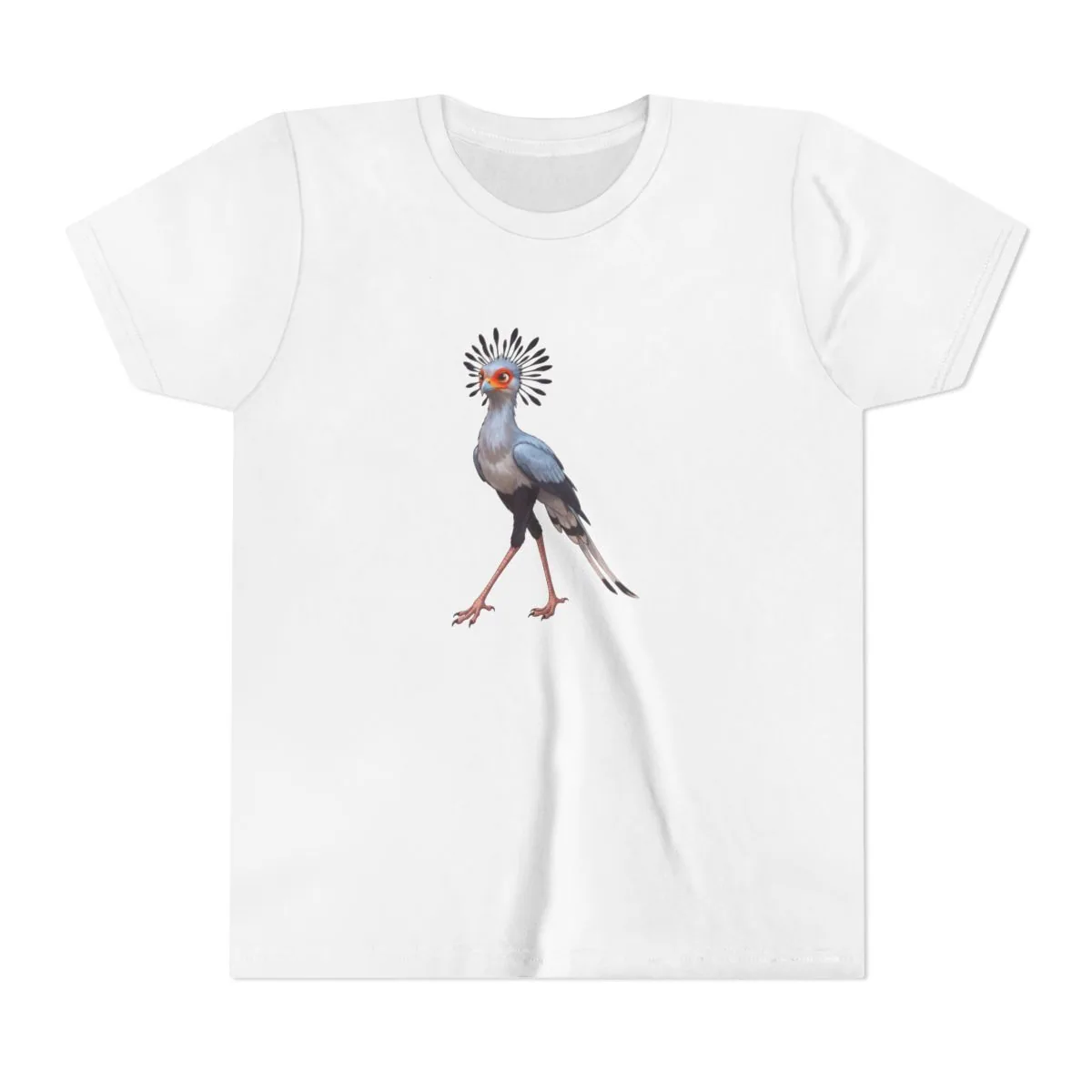
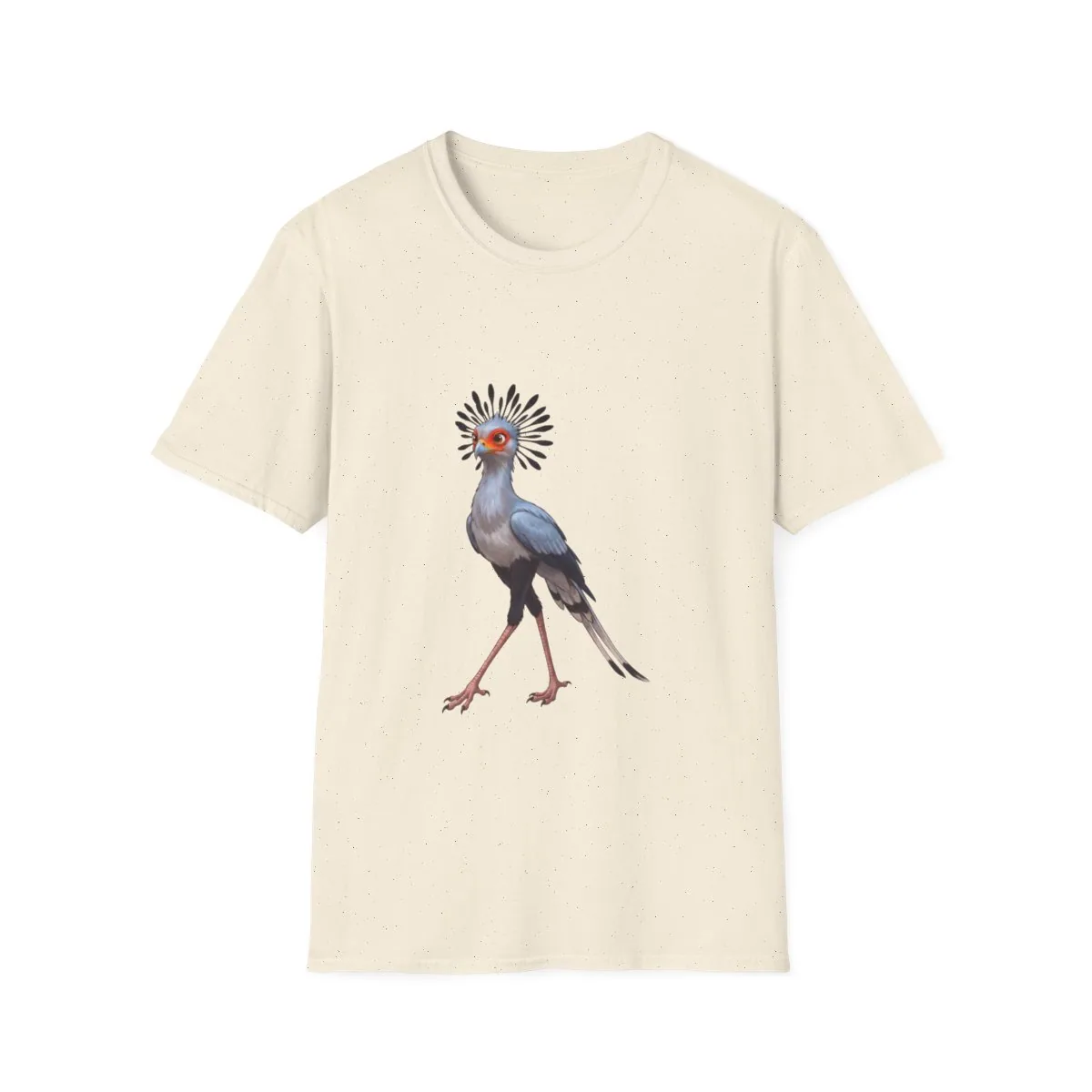
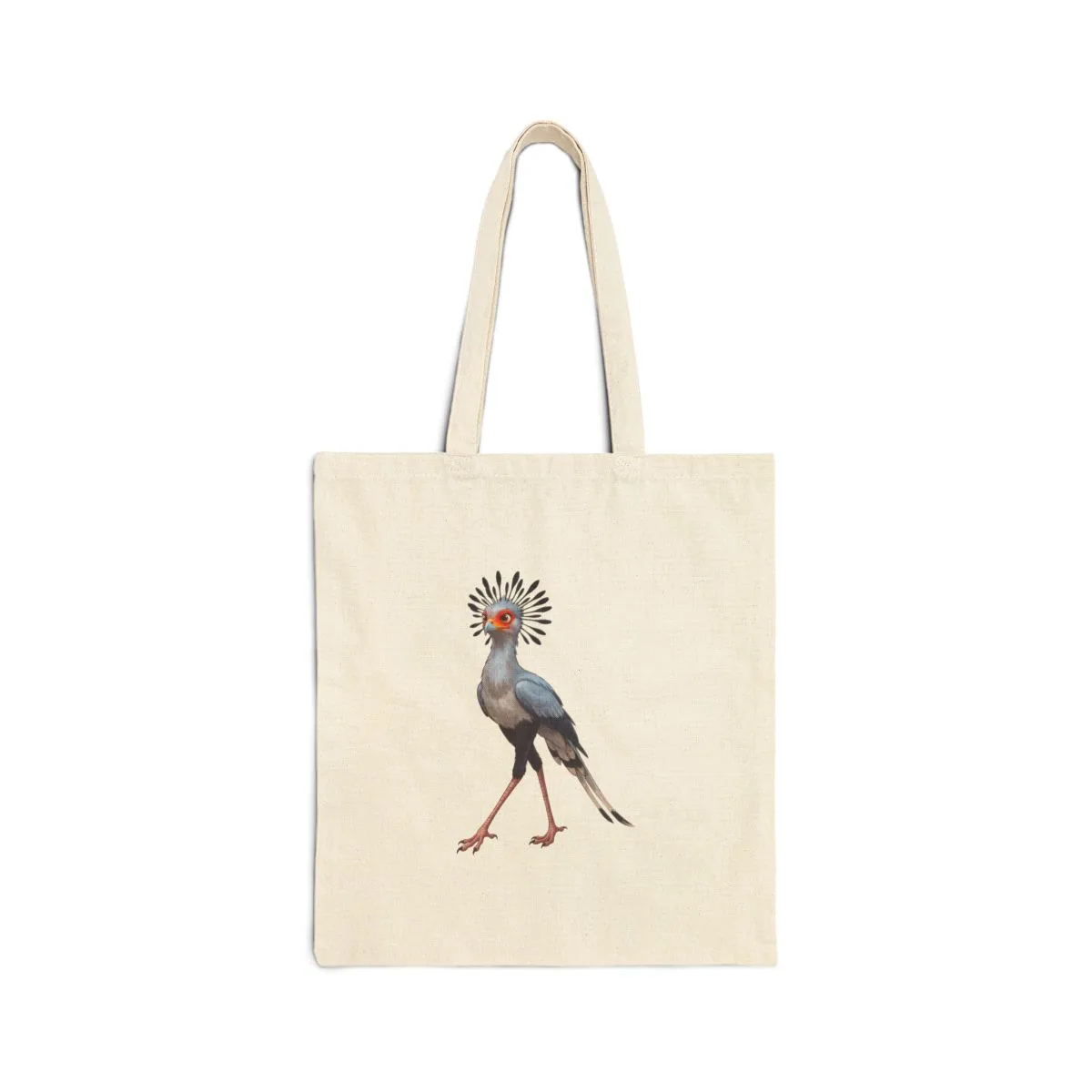
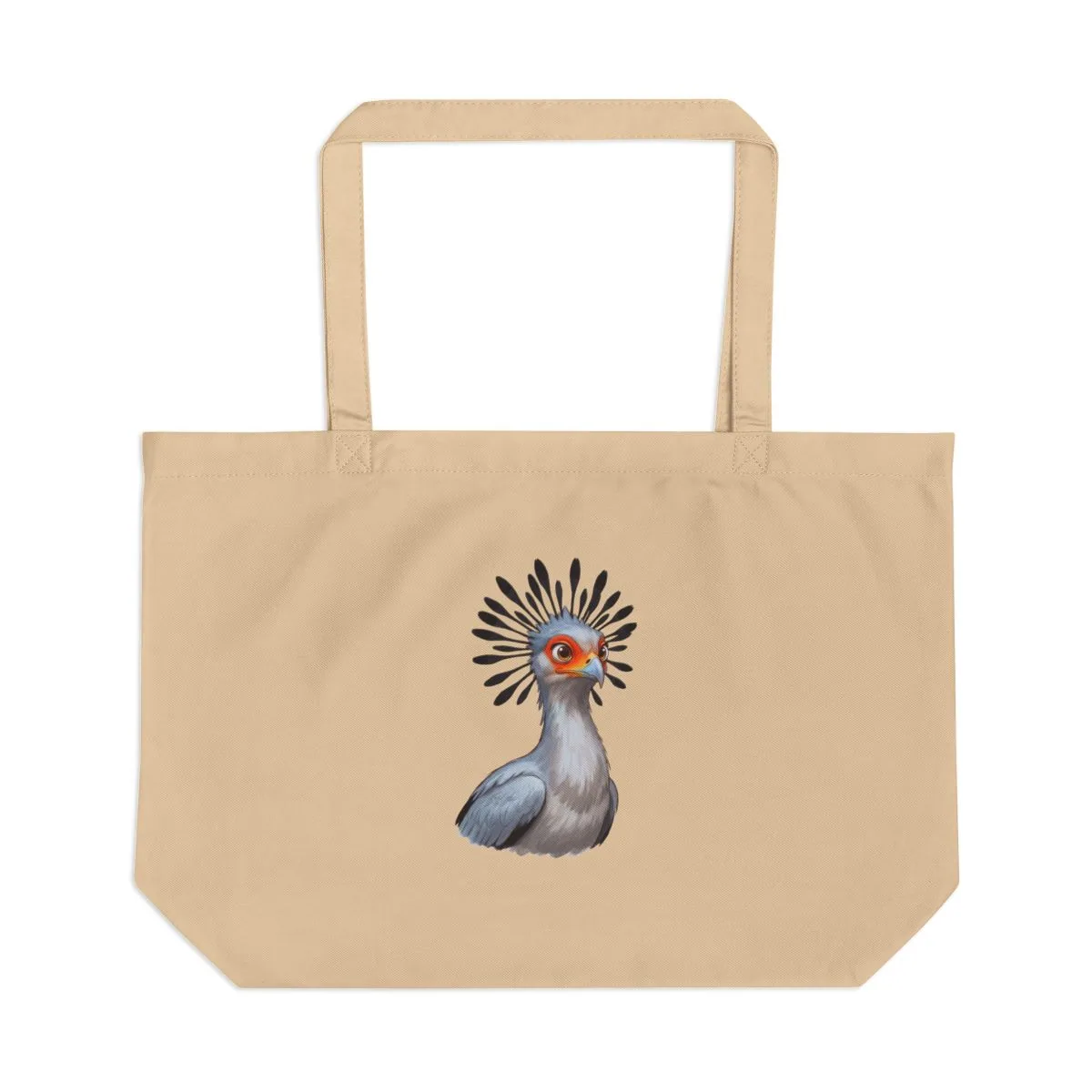
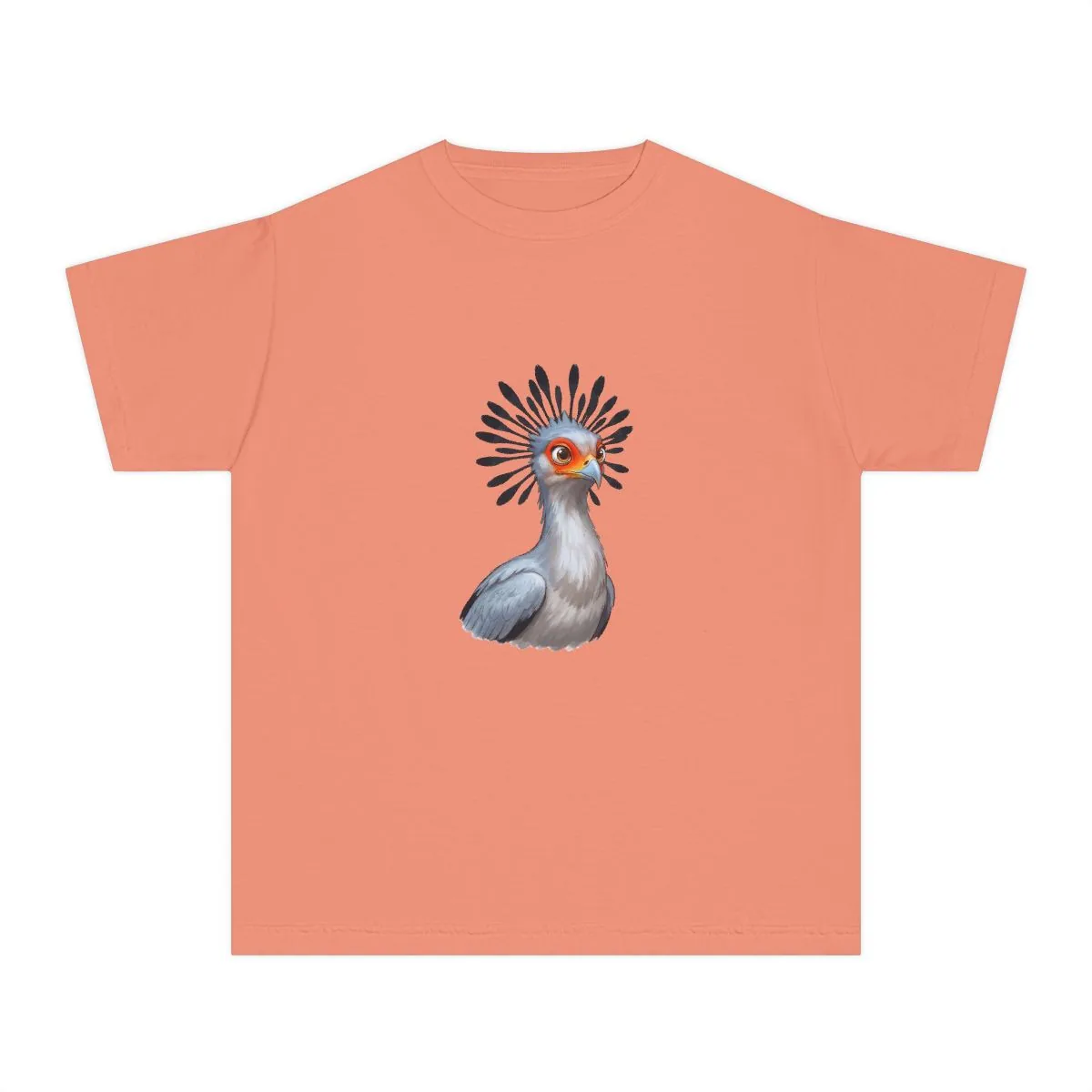
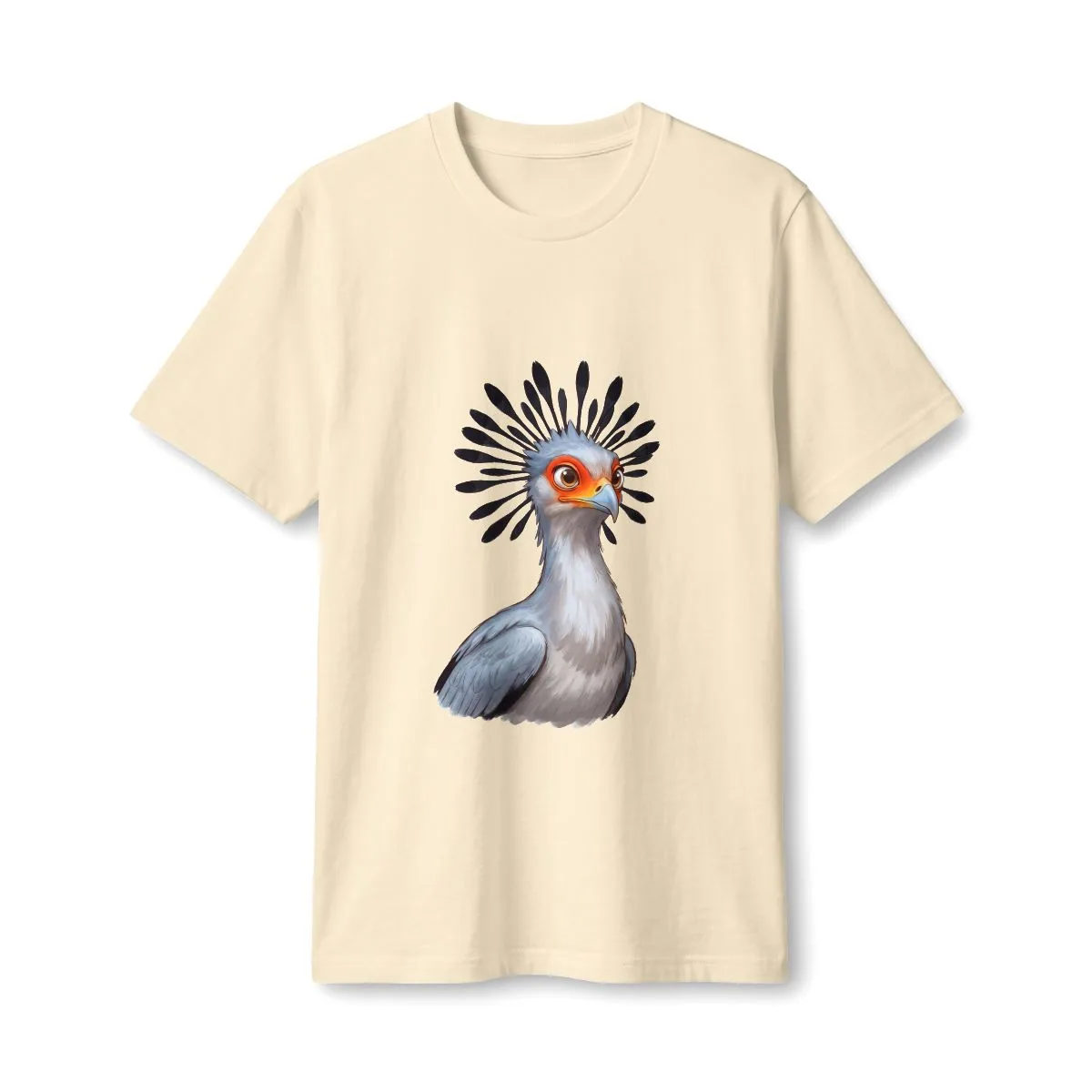
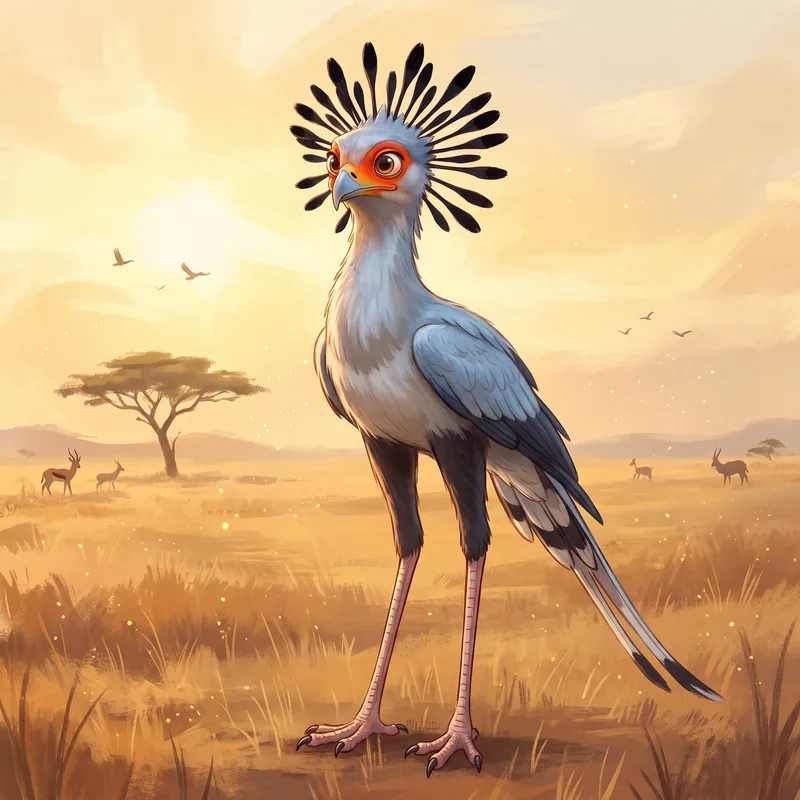
Inky is a secretary bird. She walks Africa's grasslands on the longest legs of any bird of prey, with a crest of long black feathers.

The blink kick

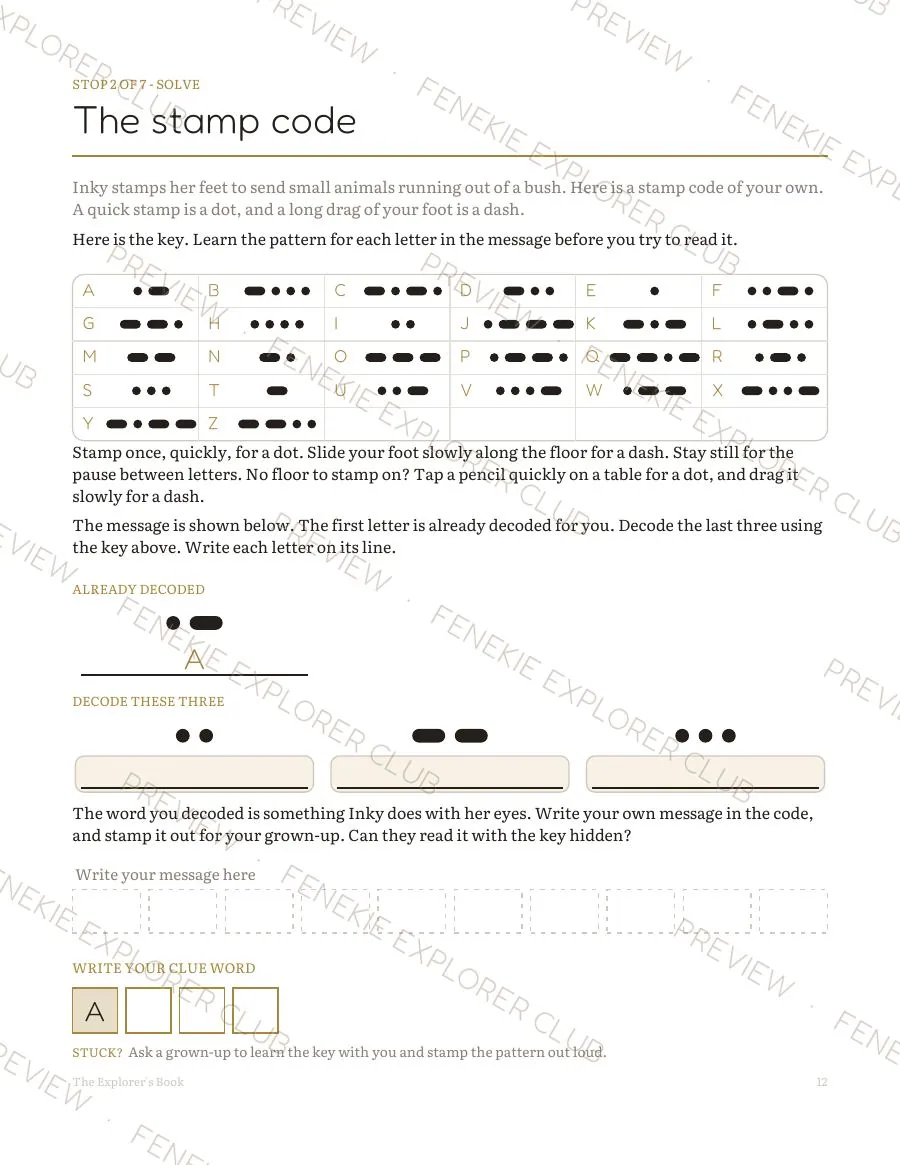
A secretary bird stamps the ground near bushes where small animals may hide, to flush them out into the open. When scientists measured one bird's kick, its foot touched for about a tenth of the time it takes you to blink.

The wide sky

Secretary birds live on Africa's savanna and open grasslands. The IUCN lists them as Endangered, and fewer walk the grass than before. People in South Africa nurse hungry, hurt ones back to health, and one ran off up the hill to explore its new home.

Week 27 · Secretary Bird

Secretary Bird: Inky the Savanna Stomper

Sagittarius serpentarius
BLINK KICK

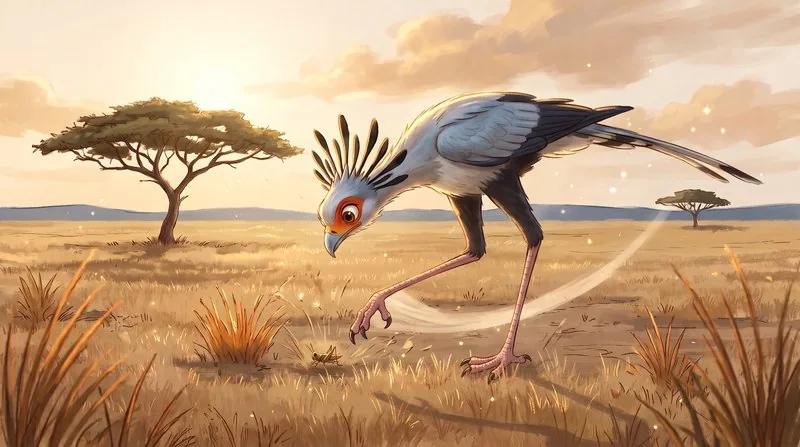
Inky walks the golden grass with her head down, on the longest legs of any bird of prey. When scientists measured one secretary bird's kick, the foot touched for about a tenth of the time it takes you to blink.

Inky the Savanna Stomper
The superpower

A kick that is over in about a tenth of a blink

Secretary Bird scene

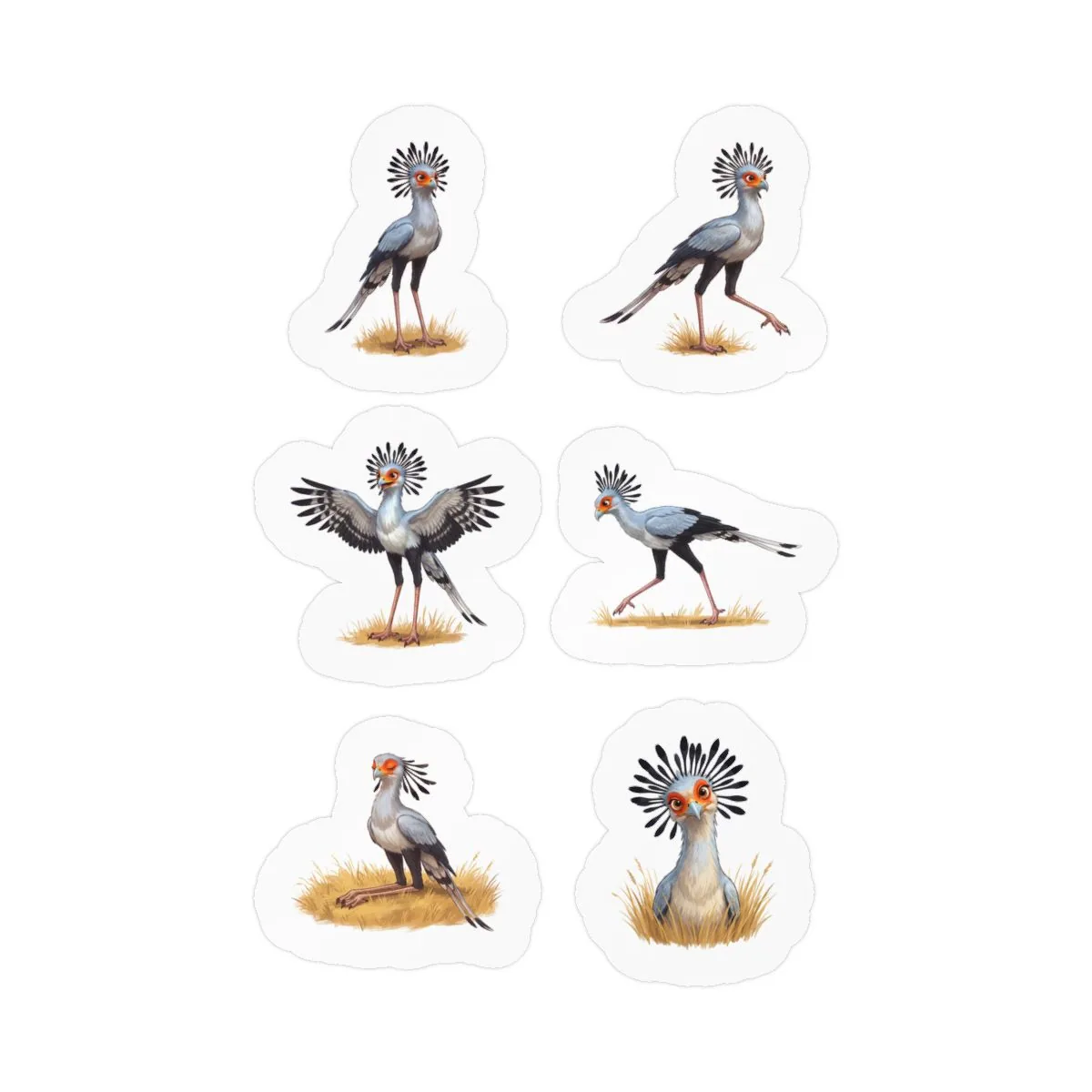
Inky is a secretary bird. She walks the open grassland and savanna of Africa south of the Sahara, from Senegal across to Somalia and down to South Africa. She is a bird of prey with an eagle's head and a crane's legs. She is the only living bird of her kind. She stands about 1.2 meters (4 feet) tall and weighs 2.3 to 4.27 kilograms (5 to 9.4 pounds). Her wings reach wider than a tall grown-up is tall. Her back and wings are grey and black, her face is orange-red, and her crest is long black feathers. The black feathers on her thighs look like shorts, and her bare legs are pink.

The power is the kick. Inky hunts on foot, walking 20 to 30 kilometers (12 to 18 miles) in a day with her eyes on the ground. She stamps beside the bushes to wake what is hiding, then kicks. When scientists measured one secretary bird's kick, it hit with about five times the bird's own weight. The foot touched for about 15 thousandths of a second, about ten times quicker than a blink. She aims with her eyes. In one South African study, insects made up 86 percent of what secretary birds ate. She can even catch snakes.

Inky spends her day walking and hunting on the ground, and goes back to her roost in the late afternoon. Her nest is a wide, flat platform of sticks on top of a flat-topped thorn tree. Both parents build it, and a pair uses it for years. When two secretary birds pair up, they can dance, wings wide open. In her story, a thin grey line hangs across her way home one evening. Then people hang small flapping markers on it, and learn to look up for her.

About 1.2 meters (4 feet) tall, on the longest legs of any bird of prey. One measured kick lasted about a tenth of a blink.
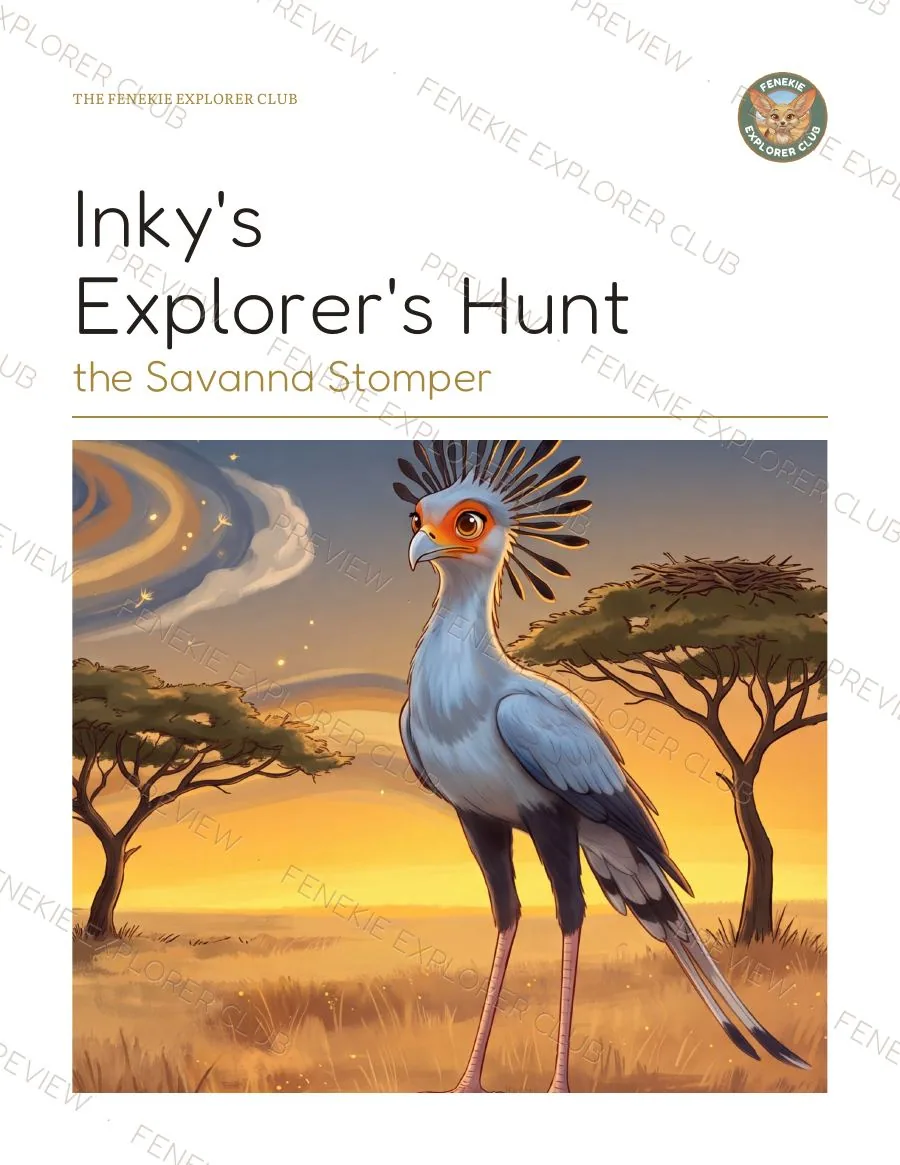
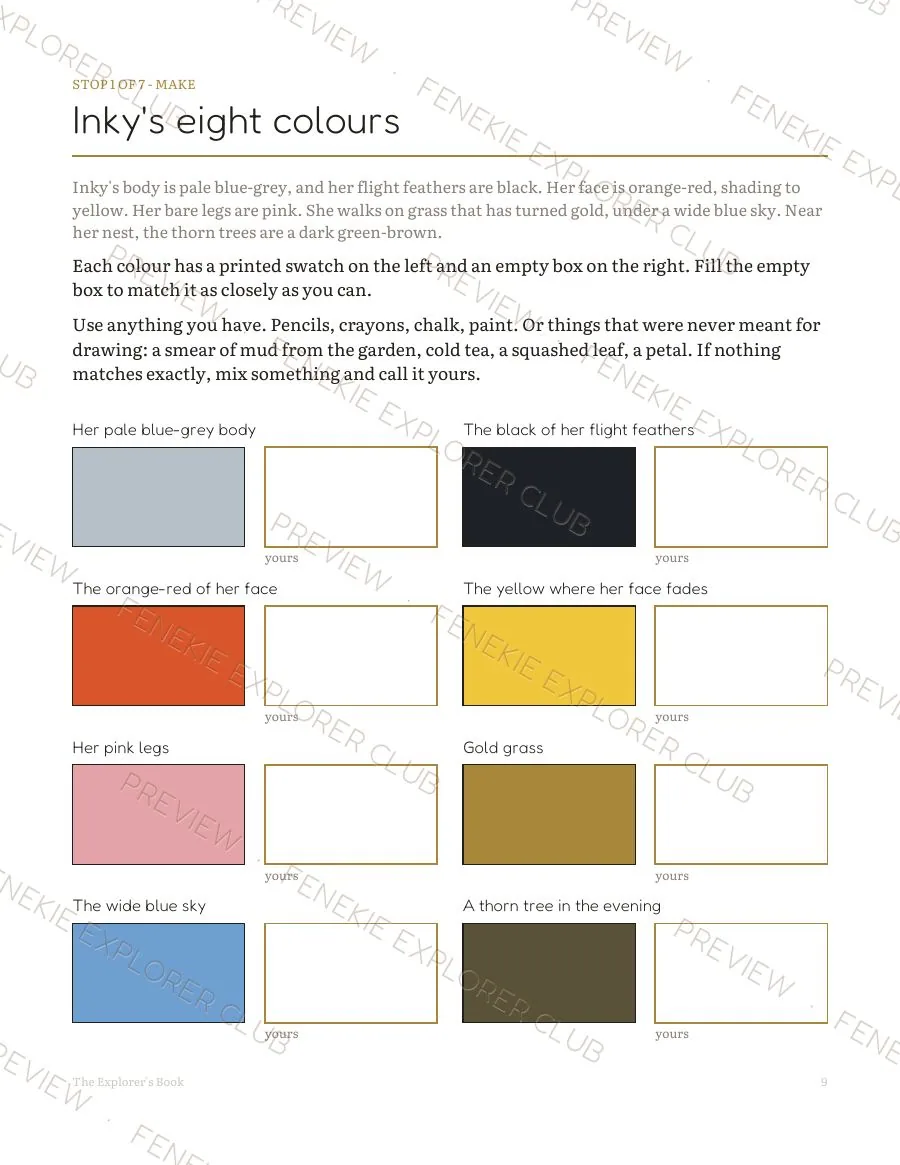
  • Page 1 of Inky's Explorer's Hunt, preview
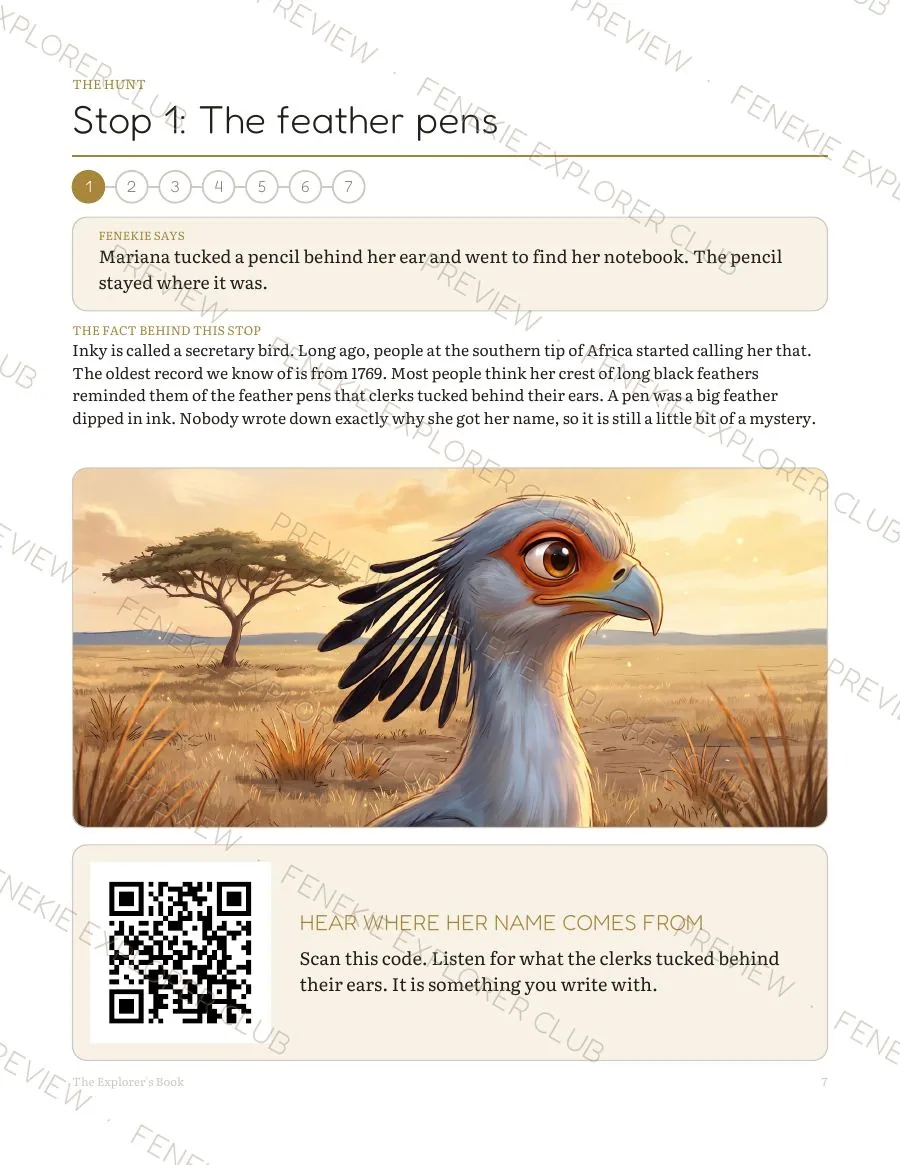
  • Page 7 of Inky's Explorer's Hunt, preview
  • Page 12 of Inky's Explorer's Hunt, preview
  • Page 9 of Inky's Explorer's Hunt, preview

4 of 42 pages, a peek inside

Free for grown-ups

Inky's Explorer's Hunt

A mystery hunt about the secretary bird. Mariana and Fenekie have hidden the clues, and your young explorer gets to find them. Leave your email and we will send the book to print at home.

No spam. Every mail has an unsubscribe link.

Watch & listen

Two ways to meet Inky

Podcast A · Discovery

Meet Inky, the Savanna Stomper

A daytime conversation. Meet the animal, and the one thing that makes it a superhero.

Podcast B · Bedtime

Inky and the Feather Pens

A gentle narrated story to drift off to. It ends with lights out.

Rather just listen? Both are podcasts too: Explorer Club on Spotify, Bedtime Stories on Spotify, or any other podcast app.

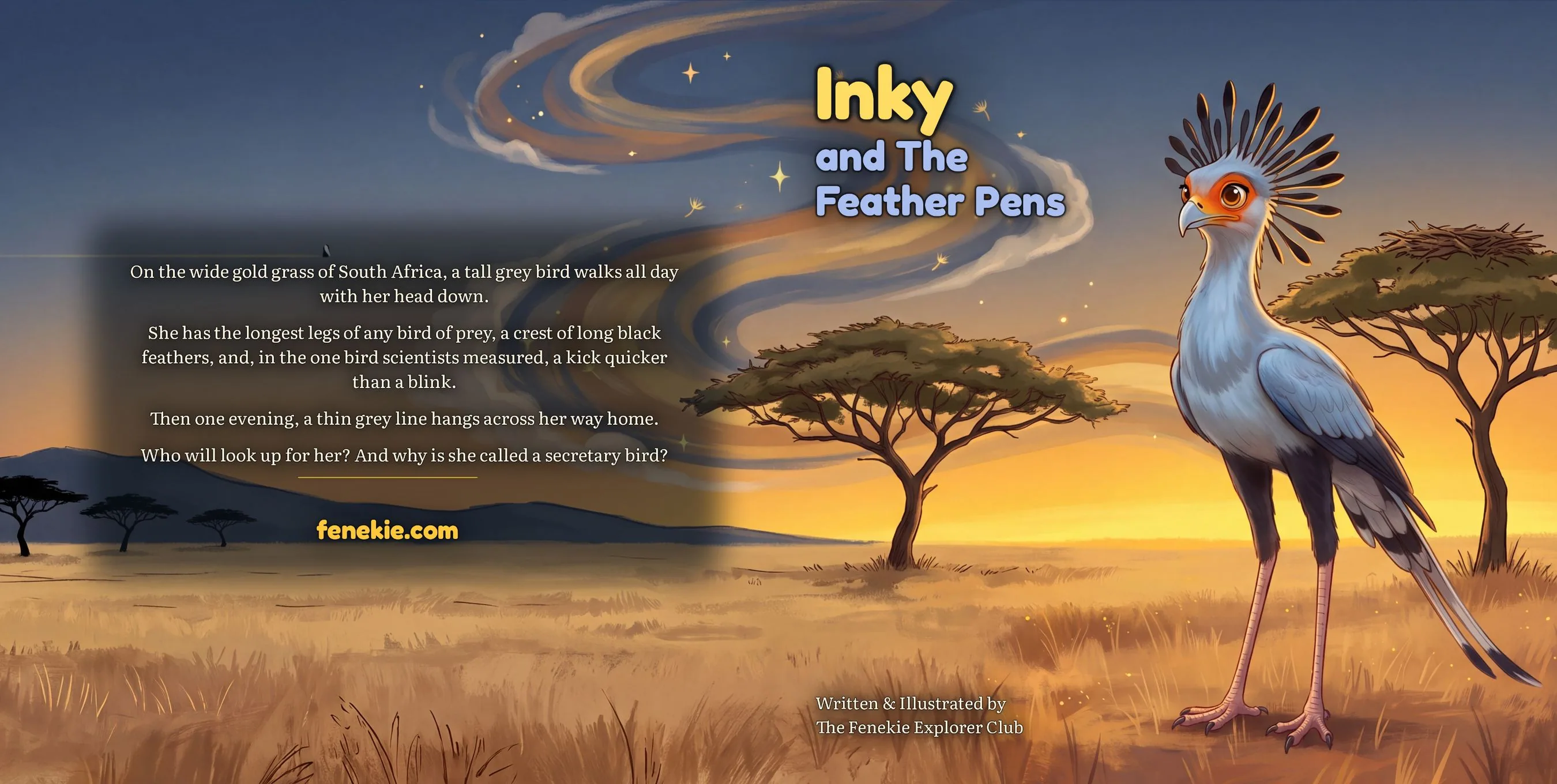
  • The Inky the Savanna Stomper storybook cover, laid flat
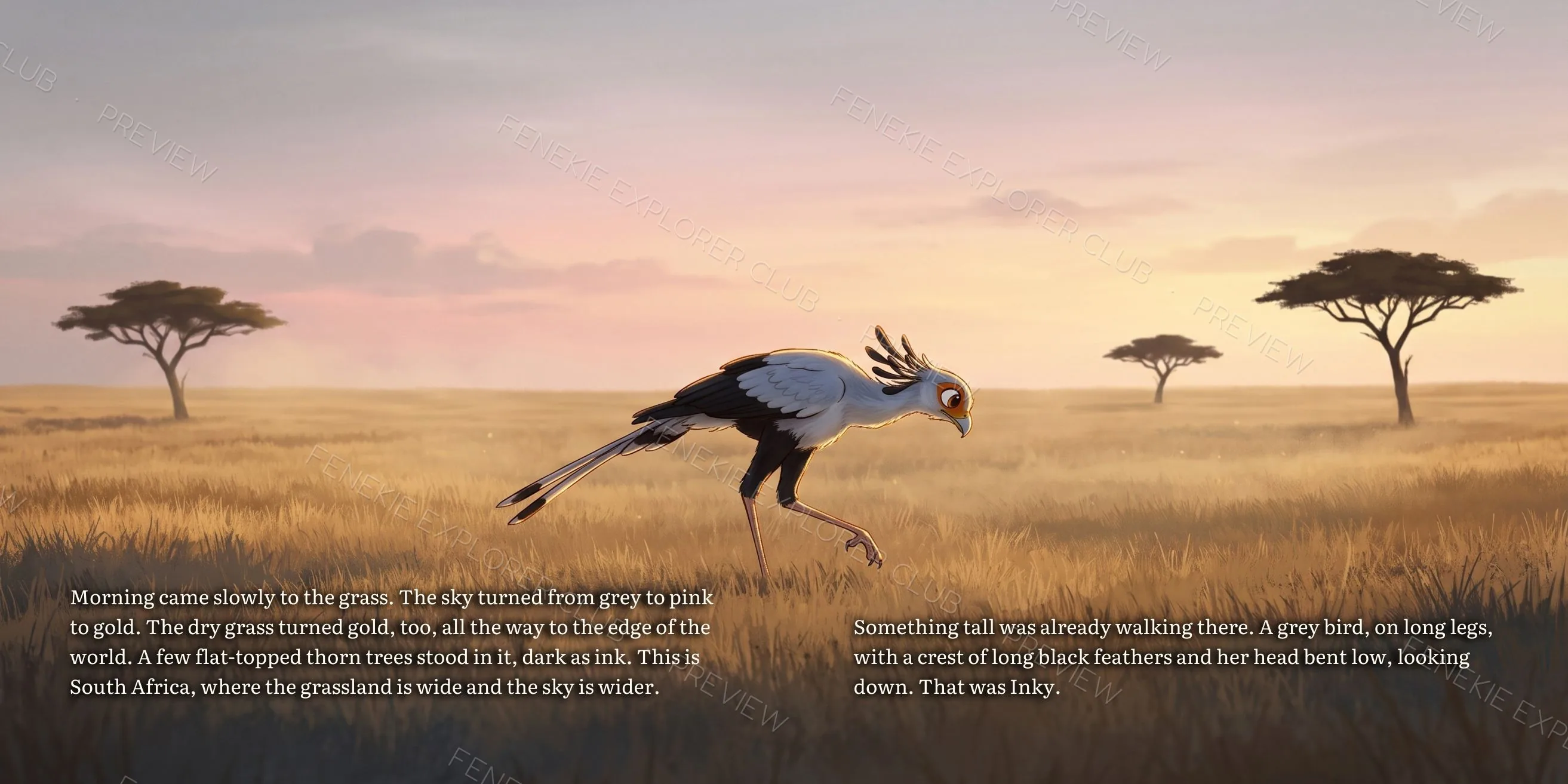
  • A spread from inside the Inky the Savanna Stomper storybook, preview 1
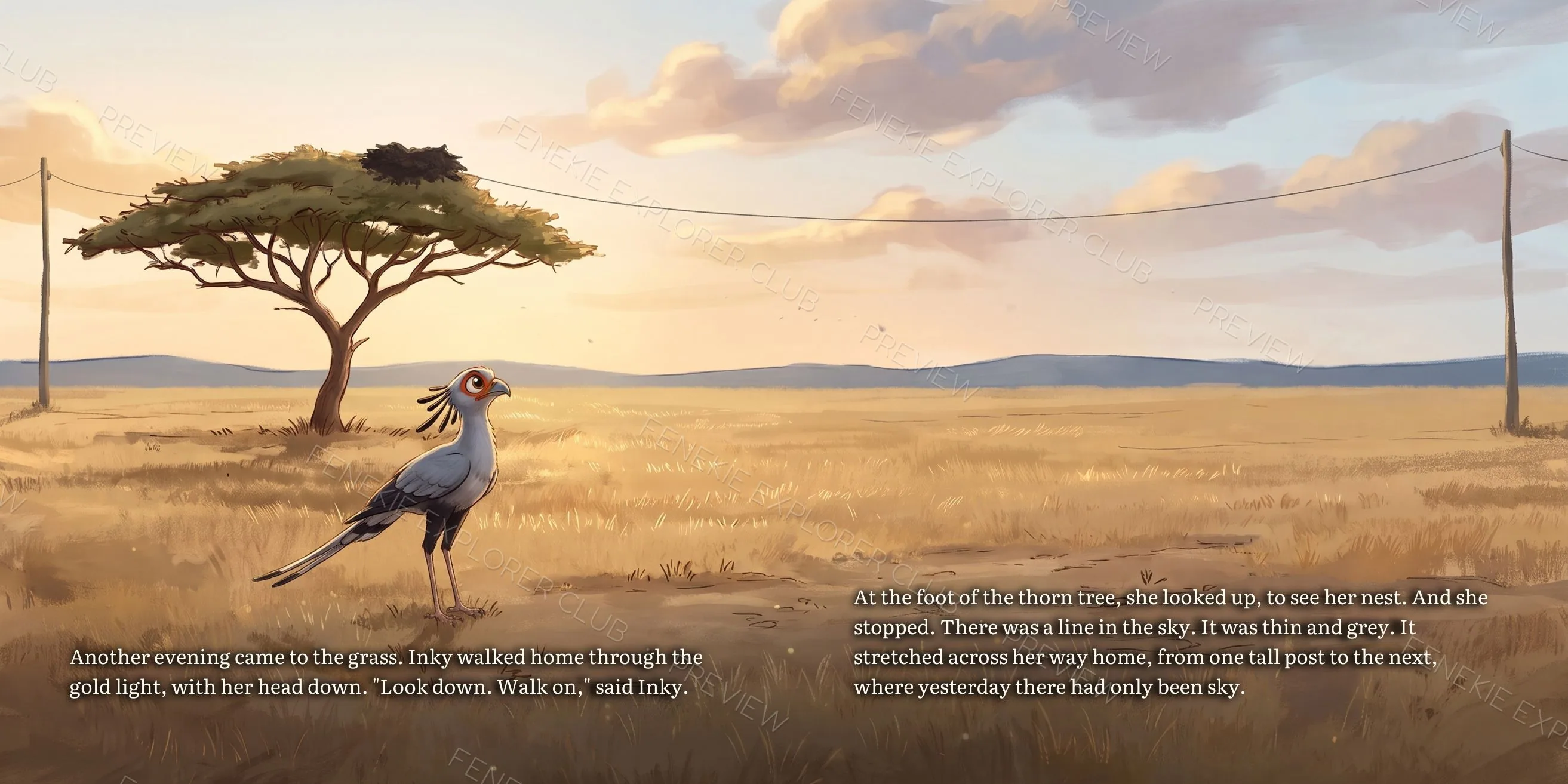
  • A spread from inside the Inky the Savanna Stomper storybook, preview 2
  • A spread from inside the Inky the Savanna Stomper storybook, preview 3

The storybook

Twenty-one painted scenes follow Inky across the wide gold grass of South Africa. A tall grey bird walks all day with her head down. Longest legs of any bird of prey. A crest of long black feathers. A kick quicker than a blink, in the one bird scientists measured. Then one evening, a thin grey line hangs across her way home. Who will look up for her? And why is she called a secretary bird? For curious explorers, ages 4-8.

Find it on Amazon
Wonder facts

Things you wouldn't believe are true

1

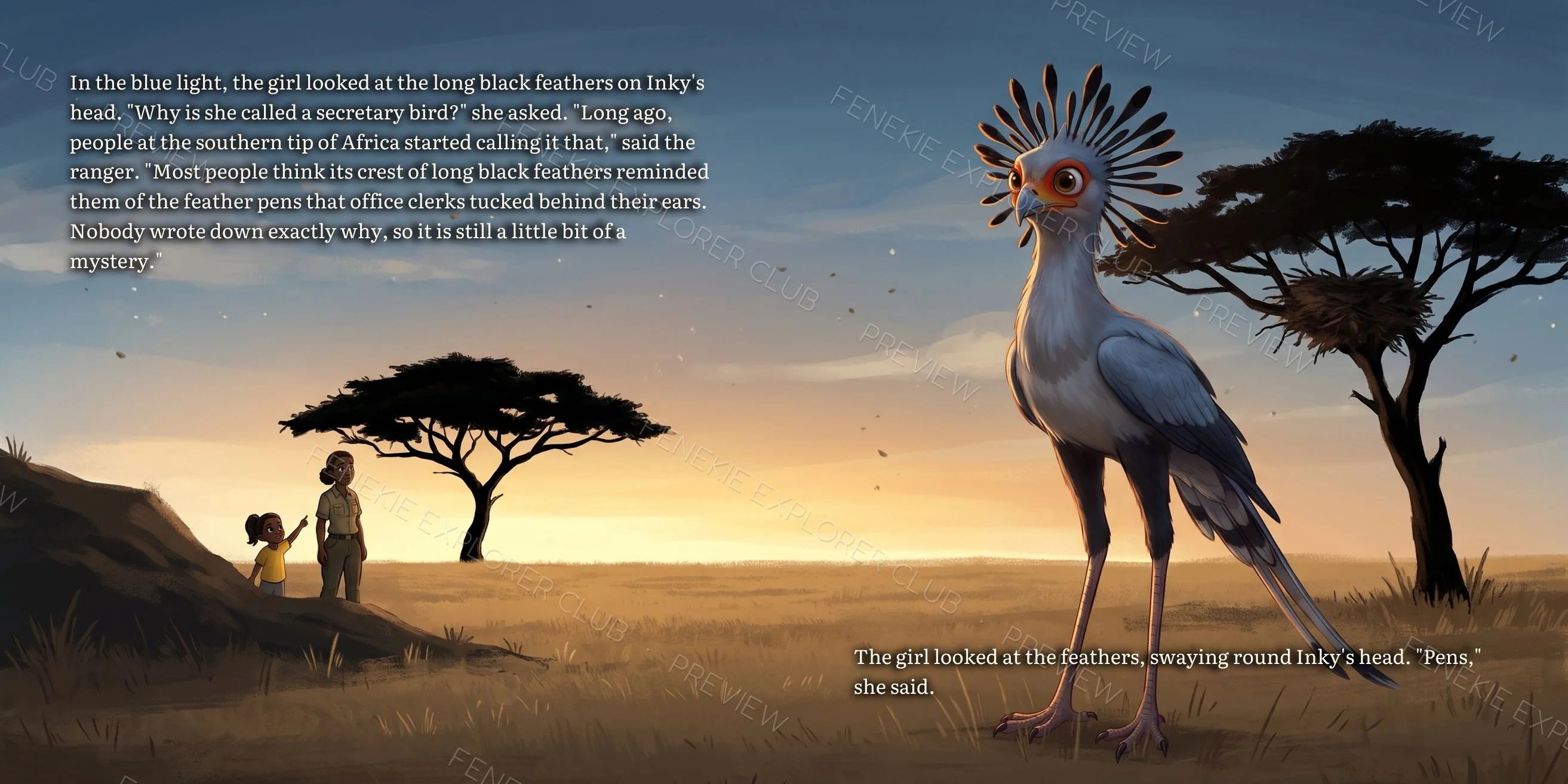
Long ago, farmers in the far south of Africa started calling her the secretary bird. Most people think her crest looked like the feather pens that office clerks tucked behind their ears. Nobody wrote down exactly why, so it is still a little bit of a mystery.

2

She has the longest legs of any bird of prey. To drink, she has to bend them into a crouch.

3

A young secretary bird's first trip out of the nest is a somewhat controlled fall. It flaps its wings a lot until it lands on the ground.

4

She is on South Africa's coat of arms, with her wings uplifted above a flower called a protea. The country's own description calls her a messenger of the heavens.

EN
Endangered
IUCN Red List, 2020
Verified at iucnredlist.org

Endangered since 2020, fewer walk the grass

Inky's kind, the secretary bird, is listed Endangered by the IUCN, the group that tracks how animals are doing worldwide. It was last checked in 2020, when it moved up from Vulnerable. Its numbers are falling. Farms and towns are spreading across the grassland. Too much grass is burned, which leaves less food. Big birds can hit power lines. In 20 years, the Endangered Wildlife Trust recorded 94 secretary birds that died on power lines. There is hope, too. In South Africa, people have tracked secretary birds since 2012 and gathered more than 600,000 GPS locations. They know of more than 300 nests. In 2025, a chick left alone in its nest for more than a week was nursed back to strength. A volunteer pilot flew it to a hunting school, and months later flew it home, where it ran off up the hill. People hang flapping markers on some power lines so big birds can see the wires. Where scientists counted in South Africa, about half as many big birds hit them. Nobody has measured it for secretary birds alone. We can love the bird that looks down, and the people who look up for her. 1% of every sale of Inky's book and shop items goes to each of two groups, Eurafrica Conservation Projects - ODV and the Dullstroom Bird of Prey and Rehabilitation Centre, for the work they do for Inky's kind and the grassland they live in.

How you can help

Safe dinners for hunting birds.

Inky hunts bugs and mice, and so do the hunting birds near you. With a grown-up, keep your garden free of poison so every hunter finds a safe dinner.

BirdLife South Africa's Secretarybird Project, for grown-ups

Where Inky's 1% goes

1% of every sale of Inky's book and shop items goes to each of these groups, for the work they do for Inky's kind and the grassland they live in.

Eurafrica Conservation Projects - ODV

In northern Tanzania and the Serengeti they watch secretary birds in the wild, follow their nests and chicks, and learn what the birds need to stay safe.

“In the wild grasslands of Serengeti and northern Tanzania, we study and protect one of Africa's most fascinating animals: the Secretarybird. Through our fieldwork, we follow these remarkable raptors, monitor their nests and chicks, and learn more about their lives and the challenges they face.”written by them for children and families
Visit Eurafrica Conservation Projects - ODV Watch their film

Dullstroom Bird of Prey and Rehabilitation Centre

Since 1997 they have taught people in South Africa about birds of prey. When a hunting bird is hurt or orphaned, they care for it, raise it if it is young, and set it free again.

“To rescue, raise, rehabilitate and release indigenous wildlife back into a natural habitat.”from their mission
Visit Dullstroom Bird of Prey and Rehabilitation Centre

Secretary Bird facts

  • What it isThe secretary bird is a large, long-legged bird of prey from Africa's grasslands south of the Sahara. It is the only living species in its family.
  • Say itIts scientific name, Sagittarius serpentarius, is saj-ih-TAIR-ee-us ser-pen-TAIR-ee-us. The common name is also written secretarybird.
  • SizeIt stands about 1.2 m (4 ft) tall, taller than a kitchen counter. It weighs 2.3 to 4.27 kg (5 to 9.4 lb).
  • Where it livesIt lives on grassland and lightly wooded savanna south of the Sahara, from Senegal east to Somalia and south to South Africa, but not in the Congo Basin.
  • What it eatsIt eats mostly insects, such as grasshoppers and beetles. It also takes mice, rats, small birds and eggs, and it can catch snakes, even puff adders and cobras.
  • Day or nightIt is awake by day and spends most of it walking and hunting for food. At night it roosts on its nest or another flat-topped tree.
  • BabiesIt lays one to three eggs in a treetop stick nest. They hatch after about 42 to 46 days, and chicks leave the nest at 64 to 106 days.
  • Who hunts itAdults are rarely hunted. Crows, ravens, ground hornbills, eagle-owls and other birds of prey take its eggs and chicks.
  • Where it came fromFossils of secretary-like birds with shorter legs, 20 million years old and older, were found in France. It is related to hawks and eagles.